
A
Air Waybill
The shipping document used for the transportation of air freight, which includes conditions, limitations of liability, shipping instructions, description of commodity, and applicable transportation charges. It is generally similar to a straight non-negotiable bill of lading and is used for similar purposes.
Authorized Economic Operator (AEO)
An Authorized Economic Operator (AEO) status is an internationally recognized quality mark that shows your role in global supply chains is established and secure. As such, it is granted by customs authorities to ensure your custom controls and procedures are efficient and meet EU standards.
AWRS
The Alcohol Wholesaler Registration Scheme (AWRS) is a regulatory initiative in the United Kingdom aimed at tackling alcohol fraud and ensuring that businesses involved in the wholesale of alcohol are legitimate and compliant with tax regulations.
The scheme was introduced to prevent the illegal trading of duty-evaded alcohol. Key features of the Alcohol Wholesaler Registration Scheme (AWRS) typically include:
– REGISTRATION REQUIREMENT
Businesses involved in the wholesale of alcohol are required to register with the scheme. This includes businesses that buy or sell alcohol for onward sale, either in the UK or for export.
– DUE DILIGENCE CHECKS
The scheme involves due diligence checks to verify the legitimacy of businesses applying for registration. This helps prevent the involvement of illegitimate or fraudulent operators in the alcohol supply chain.
– HM REVENUE & CUSTOMS (HMRC) OVERSIGHT
The HMRC oversees the AWRS and administers the registration process. They work to ensure that businesses comply with tax regulations related to the wholesale of alcohol.
– PENALTIES FOR NON-COMPLIANCE
Businesses that fail to register with the AWRS or engage in illegal trading of alcohol may face penalties, including fines and other enforcement actions.
To find out more about how we can help you with Alcohol & Excise, please click here
B
Bill of Lading
A document that establishes the terms of a contract between a shipper and a transportation company under which freight is to be moved between specified points for a specified charge.
Usually prepared by the authorized agent on forms issued by the carrier, it serves as a document of title, a contract of carriage, and a receipt for goods.
C
CDS
On 30th September 2022 the ability to make import declarations using HMRC’s CHIEF system will end. This System will be replaced with CDS (Customs Declaration Service). The ability to make export declarations using CHIEF will end on 31st March 2023.
What you need to know
The Motis Freeflow team are busy preparing for the forthcoming introduction of the new HMRC CDS system that will process import declarations from September 22, and exports from April 23.
The Customs Declaration Service (CDS) supports making import and export declarations when moving goods into and out of the UK.
CDS will require that more information is obtained from importers and exporters in order for us to complete customs entries so please expect to be providing us with more information once we reach the deadlines.
You can make declarations as soon as you have signed up to use CDS.
Clearance
Customs Clearance refers to the process of completing the necessary procedures and documentation required by Customs authorities to allow goods to enter or leave a country. It is a crucial step in international trade, ensuring that consignments comply with local laws and regulations.
In this blog we’ll look at the key aspects of customs clearance.
– DOCUMENTATION
The importer or exporter must provide various documents such as the commercial invoice, packing list and any other documents required by the customs authorities.
– DECLARATION OF GOODS
The importer or exporter needs to declare the details of the goods being shipped. This includes information such as the quantity, description, value, and weight of the goods.
– CUSTOMS DUTIES AND TAXES
Customs authorities assess duties and taxes on imported goods. The importer is responsible for paying these fees. The amount may vary based on the nature of the goods, their value, and the trade agreements between countries.
– INSPECTIONS
Customs may inspect shipments to ensure that the declared information matches the actual contents of the shipment. This is done to prevent illegal or prohibited items from entering or leaving a country.
– QUARANTINE AND REGULATORY COMPLIANCE
Some goods may be subject to additional inspections or quarantine measures to ensure they comply with health and safety standards. Compliance with specific regulations may be necessary for certain types of goods.
– CUSTOMS BROKERAGE
Importers and exporters often use the services of customs brokers who are specialists in customs procedures. These professionals help navigate the complex customs clearance process and ensure that all requirements are met.
– ELECTRONIC CUSTOMS CLEARANCE
Many countries have moved towards electronic customs clearance systems, making the process more efficient. Electronic submission of documentation and information helps expedite the clearance process.
– CUSTOMS TARIFFS AND TRADE AGREEMENTS
Customs clearance also involves understanding and applying relevant customs tariffs and trade agreements. Countries may have different tariff rates for various types of goods, and trade agreements can influence these rates.
Effective customs clearance is essential for smooth international trade, as delays or errors in the process can result in additional costs and disruptions to supply chains. Importers and exporters need to be aware of and comply with the customs regulations of the countries involved in the trade transaction.
To discuss your Customs Clearance need, please email CustomsUK@alessandroriga.co.uk or contact us.
Customs Clearance Necessary
Customs clearance is essential to ensure the smooth and permitted flow of goods across international borders. In this blog we’ll look at the key reasons why customs clearance is necessary:
– REGULATORY COMPLIANCE
Customs clearance ensures that imported and exported goods comply with the laws and regulations of the importing and exporting countries. It helps prevent the entry or exit of illegal or prohibited items and ensures adherence to all trade policies.
– REVENUE COLLECTION
Customs duties and taxes are often levied on imported goods. The processes help customs authorities calculate and collect the appropriate duties and taxes, contributing to the revenue of the importing country.
– PUBLIC SAFETY AND SECURITY
Customs clearance involves inspections to verify that the contents of shipments match the information provided in the documentation. This helps ensure the safety and security of the public by preventing the entry of hazardous materials, counterfeit goods, or items that may pose a threat.
– TRADE FACILITATION
Customs clearance facilitates international trade by providing a framework for the smooth movement of goods. When the process is efficient, it reduces delays, minimises disruptions to supply chains, and promotes the timely delivery of goods to their intended destinations.
– TARIFF AND TRADE AGREEMENT ENFORCEMENT
Customs clearance involves the application of tariffs on imported goods. Additionally, it ensures compliance with any trade agreements or preferences that may exist between the trading countries. This helps create a level playing field and prevents unfair trade practices.
– HEALTH AND SAFETY STANDARDS
Customs clearance includes checks to ensure that imported goods meet health and safety standards. This is particularly important for products such as food, pharmaceuticals, and chemicals, where non-compliance could pose risks to public health.
– DOCUMENTATION AND RECORD-KEEPING
The whole process involves the submission of various documents, including invoices, packing lists, and certificates of origin. Proper documentation is crucial for record-keeping purposes and for providing transparency in international trade transactions.
– CUSTOMS VALUATION
Customs clearance ensures that the value of imported goods is accurately assessed for the calculation of duties. This helps prevent undervaluation or misdeclaration, which could lead to revenue loss for the importing country.
– QUARANTINE AND ENVIRONMENTAL PROTECTION
Some goods may be subject to quarantine or environmental protection measures. The processes include checks to ensure that imported goods comply with these measures, preventing the introduction of pests or contaminants.
– NATIONAL SECURITY
It plays a role in national security by preventing the movement of goods that could threaten a country’s security or be used for illegal activities.
So, to summarise, customs clearance is an essential component of international trade, serving to regulate, document, and facilitate the movement of goods while ensuring compliance with legal, financial, and security requirements. It helps create a transparent and controlled environment for cross-border trade.
To talk to us about your business’ needs and to find out more about why customs clearance is necessary, please email CustomsUK@alessandroriga.co.uk or contact us
E
EORI
An EORI (Economic Operators Registration and Identification) number is a unique identifier assigned to economic operators engaged in international trade. It is used by customs authorities and other government agencies to track and monitor shipments entering or leaving a customs territory.
It helps streamline customs procedures and ensures that businesses are properly registered for trading activities.
KEY POINTS ABOUT EORI NUMBERS INCLUDE:
– UNIQUENESS
Each EORI number is unique to a specific economic operator or business entity. It is used as a common reference number in interactions with customs authorities and other relevant government agencies.
– INTERNATIONAL TRADE
The EORI number is particularly important for businesses involved in cross-border trade. It is used to identify and track shipments, enabling customs authorities to associate goods with specific traders.
– CUSTOMS DECLARATION
When businesses engage in import or export activities, they are typically required to include their EORI number on customs declarations and other relevant documents. This ensures that the customs authorities can identify and process the shipments correctly.
– EU EORI NUMBER
In the context of the European Union (EU), the EORI number is a legal requirement for businesses engaged in customs activities. It is used for trade within the EU member states and interactions with customs authorities. Both EU and non-EU businesses may need one when trading with EU countries.
– REGISTRATION PROCESS
Businesses need to apply for one through the customs authorities of the relevant country or economic bloc. The registration process typically involves providing information about the business, its activities, and its trading partners.
– RESPONSIBILITY
The responsibility for obtaining and using an EORI number lies with the economic operator engaged in international trade. This can include importers, exporters, customs agents, and other entities involved in the supply chain.
– FACILITATION OF CUSTOMS PROCEDURES
The use of EORI numbers facilitates customs procedures by providing a consistent and unique identifier for economic operators. It helps ensure that customs processes are efficient, accurate, and compliant with relevant regulations.
It’s important for businesses engaged in international trade to obtain and use an EORI number as required by the customs authorities of the countries involved.
The specific requirements and processes for obtaining one can vary by jurisdiction, so businesses should check with the relevant customs authorities for guidance.
H
Harmonized System (HS)
The Harmonized System (HS) is an international classification system administered by the World Customs Organization. It is used by organizations, importers, exporters and customs to classify goods to ensure accurate duties, taxes, and documentation are applied.
I
INCOTERMS
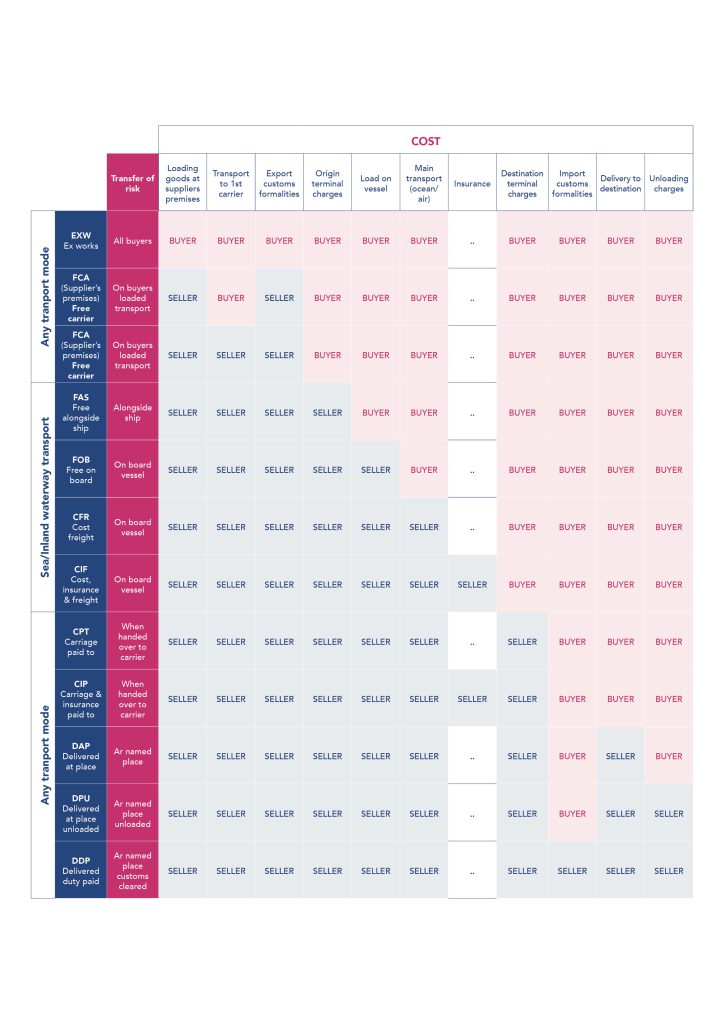
Incoterms or otherwise known as “International Commercial Terms” are a set of 11 globally recognized 3-letter trade terms created by the International Chamber of Commerce (ICC).
They are used to establish rules and/or arrangements for the delivery of goods to facilitate domestic and international B2B trade, for example, DPP = Delivered Duty Paid or DAT = Delivered at Terminal.
R
The Rules of Origin
(RoO) in the UK were influenced by the UK’s departure from the European Union (EU). The specifics of RoO can change, so it’s essential to check the most recent and updated information. You can do that on the Gov website here.
Here are some general principles that were applicable around that time:
– PREFERENTIAL RULES OF ORIGIN:
For goods to qualify for preferential tariffs (lower or zero tariffs) under trade agreements, they must meet certain RoO criteria.
The rules typically specify the percentage of local content or value-added required in the product for it to be considered as originating from the country in question.
– NON-PREFERENTIAL RULES OF ORIGIN:
These rules are applied to determine the origin of goods for purposes other than obtaining preferential tariffs, such as anti-dumping measures or labelling requirements.
– CUMULATION:
Cumulation allows the use of materials or processing from one or more countries in the calculation of the origin of a product. Bilateral or diagonal cumulation might be in place depending on the trade agreement.
– PRODUCT-SPECIFIC RULES:
Different products may have different RoO criteria. These criteria can include the percentage of local content, specific manufacturing processes, or other criteria.
– DOCUMENTARY REQUIREMENTS:
Importers and exporters need to provide documentation demonstrating that their goods meet the RoO requirements to claim preferential tariff treatment.
– ADMINISTRATIVE COOPERATION:
The relevant customs authorities of the trading partners cooperate to ensure the correct application and enforcement of Rules of Origin.
To experience our assured customer service, contact us today
S
SIVEP
SIVEP wishes to remind of certain rules regarding the certification of compound products, in accordance with Regulations 852 and 853/2004. Compound products are foodstuffs containing both processed ingredients of animal origin and plant origin, such as cakes with milk and flour or lasagna.
Certification must be based on the exact composition of the product. If two distinct products are present (for example, beef and chicken samosas), they cannot appear on the same certification. In this case, two EHCs are necessary, one for the beef product and another for the chicken product. On the other hand, if both ingredients are mixed in the same final product, a single certification is sufficient.
W
WOWGR
WOWGR stands for Warehouse keepers and Owners of Warehoused Goods Regulations, and typically relates to the management, operation, and oversight of warehouses where goods are stored. These regulations often cover aspects such as:
– LICENSING AND REGISTRATION
Requirements for warehouse operators to obtain proper licenses or registrations to operate a warehouse legally.
– RECORD-KEEPING
Regulations may specify the types of records that warehouse keepers must maintain, including details about the goods stored, their owners, and any movements in or out of the warehouse.
– SECURITY AND SAFETY
Regulations may outline security measures to protect the goods stored in warehouses, as well as safety standards for both employees and stored items.
– LIABILITIES AND RESPONSIBILITIES
Guidelines regarding the responsibilities and liabilities of warehouse keepers and owners of goods in case of loss, damage, or other incidents.
– CUSTOMS AND DUTIES
If the warehouse deals with imported or exported goods, there might be regulations related to customs procedures and duties.
To learn more about WOWGR and how we can support your business, please contact us.